Although the use of digital technology in modern dentistry has already made the diagnosis, treatment planning and execution of dental restorations more efficient, yet this area still provides integration opportunities. Intraoral scanning is one technology that has found a utility in several dental procedures. Digital impression devices: They provide an impression of the teeth and surrounding oral structures without needing materials or a tray.
In select cases where conventional dental impressions are not ideal for patients, digital scanning can provide a more comfortable alternative. The digital model can then be examined on a computer and is sometimes utilised for treatment planning, orthodontic treatment requiring crowns or bridges, aligners as well as other restorative procedures.
What Is Intraoral Scanning?
Abstract: Intraoral Scanning is a digital dental process during which a small wand can be used to scan the inside of your mouth and create permanent records of an impression. The scanner is passed continuously over the teeth and neighboring areas, taking multiple images which are compiled by special software together as a three-dimensional digital representation.
The dentist takes a small scanning wand and, instead of filling up a tray with impression material for the patient to bite into, simply scans in the needed information.
The specific scanning procedure varies based on the type of equipment used as well as the dentistry treatment.
How Does Intraoral Scanning Work?
Usually, the first step includes a dental examination. The dentist decides how many areas should need to be scanned depending on the treatment needed.
From here, the intraoral scanning equipment is delicately moved over the teeth. As the scanner travels across the mouth, it takes numerous images. Such images are then exploited by specialized software to concoct a digital 3D representation.
The dentist then can see the model and look around the teeth on a computer screen. The digital file is subsequently used to create restorations or plan orthodontic and restorative procedures depending on the process.
Benefits of Intraoral Scanning
This is not only a comprehensive list of advantages but one of the main advantages that I noticed is creating a digital dental impression without conventional impression material.
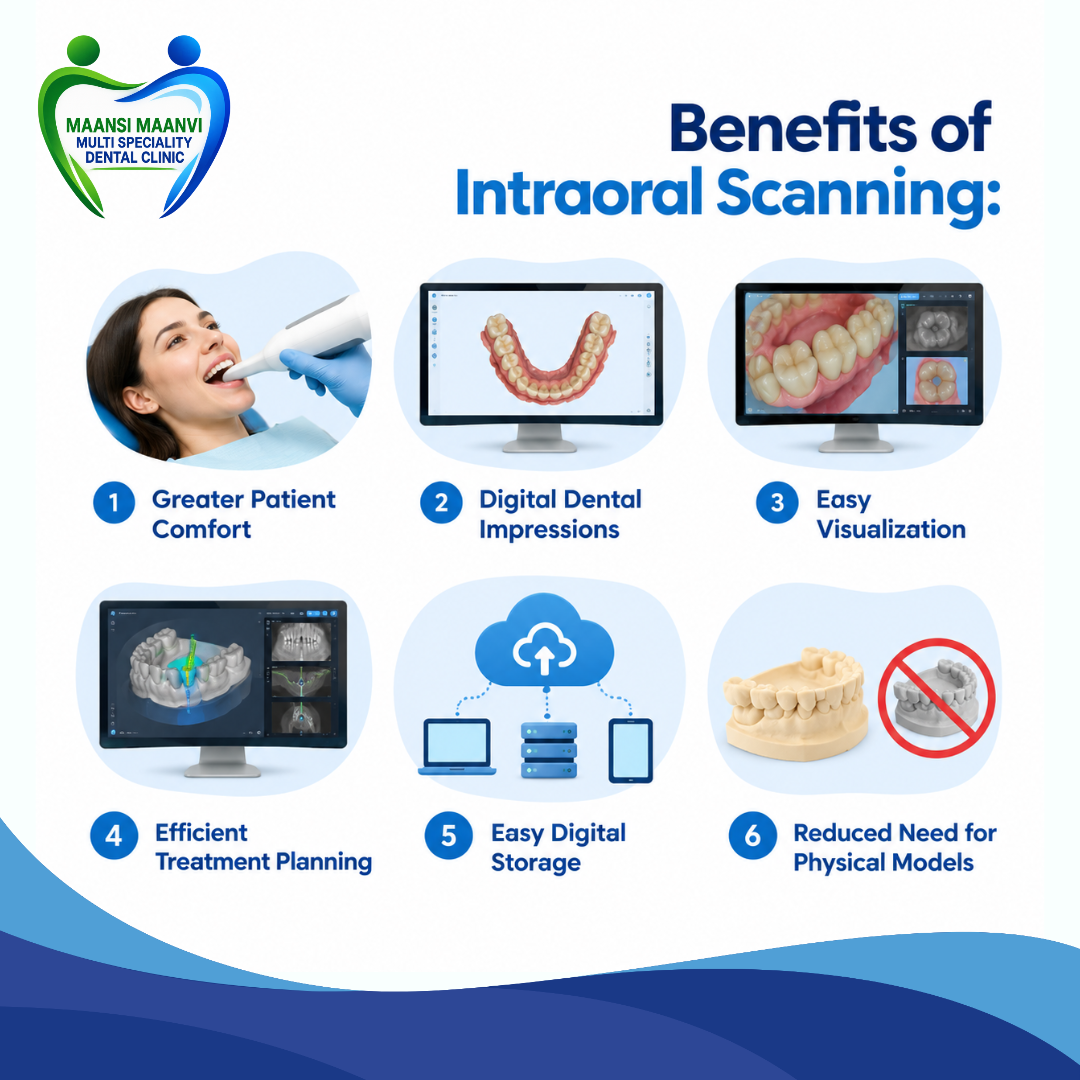
Greater Patient Comfort
Conventional impressions can be uncomfortable and even elicit a gag reflex. Many cases are suitable for digital scanning, which can remove the need of a large impression tray full with impression material.
Digital Dental Impressions
It forms a digital representation which can be viewed and evaluated electronically. This can also help to make the impression process easier for both patients and dentists.
Easy Visualization
This digital model can be visualized on a computer. It allows rotating, enlarging and inspecting various parts of the model by the dentist.
Efficient Treatment Planning
Digital models to aid planning for select procedures (eg, crowns, bridges, aligners, orthodontic treatment and other restorative work)
Easy Digital Storage
They can be stored electronically in the form of digital scans, as a component of proper dental records. This could simplify the process of obtaining the digital model of a patient whenever it is required for continued treatment.
Reduced Need for Physical Models
Digital scanning can also help eliminate the need for traditional physical dental casts and compressible impression materials where appropriate.
What Are Intraoral Scanners Used For?
Intraoral Scanning can be used in several areas of modern dentistry.
Crowns and Bridges
While planning crowns and bridges digital scans can show the position of your teeth and their shape. The digital readouts can be part of the entire design and manufacturing workflow process.
Clear Aligners
Digital dental scans can create digitised models of the teeth for orthodontic planning These models provide support for clear aligner treatment design when clinically indicated.
Braces and Orthodontic Treatment
Digital models can assist dentists and orthodontic professionals in the assessment of displacement and certain types of orthodontic treatment planning.
Dental Implants
For certain implant cases, in some instances digital scans can be incorporated with ancillary diagnosis to help treatment planning. Imaging requirements depend on the case.
Cosmetic Dentistry
Wherever the procedure is a little more complicated, digital models can sow planning with complete detail about each tooth’s position and shape before beginning some of these cosmetic dental procedures.
Is Intraoral Scanning Accurate?
The accuracy of Intraoral Scanning is influenced by a variety of factors such as the scanner technology, scanning technique, moisture control, scanned surface area and clinical situation.
Modern scanners are meant to capture copious detail of the digital information, but no digital technology is automatically right for every application.
Your dentist decides how well-suited digital scanning is for the procedure and what other images or records are needed.
Intraoral Scanning vs Traditional Dental Impressions
Regular impressions utilize impression material loaded in a tray. The physical negative impression of the teeth is created by biting into the material, allowing it to set.
Digital scanning is a fairly new procedure that works by taking an electronic image of the teeth using a hand-held scanner that allows the dental office to create a digital model including impressions of all of your teeth.
Here are Some benefits of digital Scanning:
- No traditional impression material
- Better comfort of patients in appropriate cases
- Immediate digital visualization
- Easy electronic storage
- Convenient communication with dental laboratories
- Digital workflow for selected restorations
- Useful for orthodontic treatment planning
Traditional impressions are still an important part of dentistry to this day, and it is really a balance between the treatment and the clinical situation as to which method is appropriate.
What Happens During an Intraoral Scan?
Before intraoral scanning, the dentist checks the patient’s mouth and determines which parts need to be recorded.
The scanning wand then is swept over the teeth. Based on the treatment needed, the dentist scans the upper teeth, lower teeth and bite relationship.
The software then shows the information that it captures on a screen. Instead of having to perform a new, entire conventional impression if an area is missing or unclear, the dentist can simply rescan that particular region.
Once the scan is completed, we can examine the digital model and use it to formulate a treatment plan moving forward.
Is Intraoral Scanning Safe?
Abstract Intraoral Scanning is one among the non-invasive digital impression techniques. Digital impressions are captured without the use of X-rays or ionizing radiation.
The scanner is positioned inside the mouth and runs all over the teeth. Patients may feel some mild discomfort from the scanner or holding their mouth open for a period, but there is no drilling or cutting of the teeth involved in this procedure.
The dentist would explain the procedure and feel whether it is suitable for the proposed treatment.
Maansi Maanvi Multispeciality Dental Clinic Intraoral Scanning
It is a one-stop destination for restorative, cosmetic orthodontic and implant related dental services. Its website describes the clinic’s approach as patient-centered one, backed-up with current dental technology.
Intraoral Scanning – For patients opting for intraoral scanning, the dentist monitors what needs to be done and whether taking a digital impression makes sense in the course of treatment. Digital scanning may only gain relevance in selected treatments relating to crowns, bridges, ortho, aligners, and any other restorative procedures.
The Maansi Maanvi Multispeciality Dental Clinic is a professional crown & bridge dental implant clinic providing braces, aligners, cosmetic dentistry, root canal treatment and more.
Who Can Benefit From Digital Dental Scanning?
For this purpose, you can use digital scanning for patients with many dental treatments:
- Crown treatment
- Bridge treatment
- Clear aligner treatment
- Orthodontic treatment
- Selected implant procedures
- Cosmetic dental procedures
- Restorative dental treatment
However, not every patient/procedure needs to be scanned digitally. The dentist determines what records are required based on the treatment plan.
Frequently Asked Questions
Does intraoral scanning hurt?
No. Scanning is not usually an invasive procedure. Patients may feel slight discomfort from the scanner or mouth being open even then no cutting, no drilling.
How long does an intraoral scan take?
This could take a different duration, depending on the scanner, treatment and amount of information required. Most of the normal, routine scans can be finished in a reasonable timeframe.
Can intraoral scanning replace dental impressions?
Digital scanning can take the place of traditional impressions in various appropriate cases. But the ideal way depends on the procedure and the dentist’s clinical judgment.
Can intraoral scanning be used for braces?
Yes. For orthodontic assessment and treatment planning, orthos can be based on digital dental models; these may include certain braces or clear aligner treatments.
Is An Intraoral Scan The Same As A Dental X-ray?
No. An intraoral scanner images the visible surfaces and geometry of tooth and oral structures. A dental X-ray is an imaging technique that allows visualization of structures below or within the teeth and jaw via radiation.
Conclusion
Advancements in technology have transformed how dental treatments are conceptualized and provided over the years. Intraoral Scanning is a digital approach to capture dental impressions and offers patient comfort, immediate visualization, digital storage, and support for selected restorative and orthodontic treatment.
Implants, crowns, bridges, aligners and orthodontic procedures or cosmetic dentistry are some of the areas for which the technology could be especially valuable. Not every patient will require scanning, so the digital workflow solution would be case specific.
To find out whether digital scanning is suitable for you, discuss with your dentist if you are planning to get crowns, bridges, aligners, braces, implants or cosmetic dentistry.